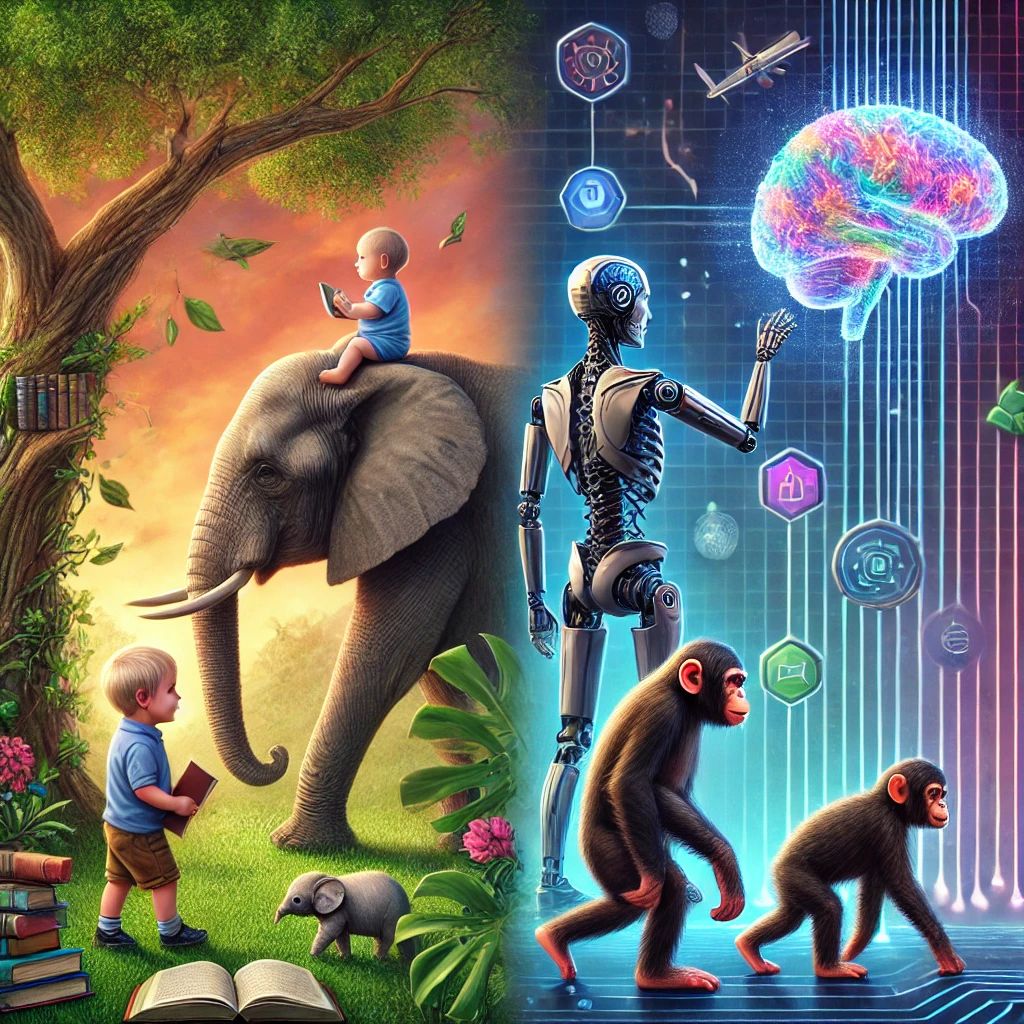
In the natural world, intelligence is often correlated with the length of development time after birth. Species that take longer to mature tend to exhibit higher cognitive abilities, as this extended period allows for learning, socialization, and skill acquisition. This principle applies not only to humans but also to other highly intelligent animals like great apes, elephants, whales, and some birds. Interestingly, this concept can also be observed in artificial intelligence (AI), where longer training times generally lead to more sophisticated and capable models.
The Biological Perspective
In mammals and birds, a prolonged childhood provides the opportunity for complex learning. Humans, for instance, take years to fully develop, using this time to absorb knowledge, build social connections, and refine problem-solving abilities. Other species with extended developmental periods include:
Great Apes (Chimpanzees, Orangutans, Gorillas) – These animals require several years of parental guidance to learn tool use, communication, and survival strategies.
Elephants – Young elephants stay with their herds for over a decade, learning complex social behaviors and navigation skills.
Whales and Dolphins – These marine mammals develop slowly, relying on parental instruction and social learning for survival.
Albatrosses – Some seabirds, like albatrosses, take years to mature, learning extensive navigation skills over time.
Conversely, species like octopuses, despite having large and complex brains, do not have long childhoods. Most octopuses live only a few years, and their offspring receive no parental care. This short lifespan and lack of guided learning may limit their ability to develop intelligence beyond instinctual behavior, despite their impressive problem-solving capabilities.
The AI Parallel
In artificial intelligence, the length of training is a crucial factor in determining an AI model’s capabilities. AI systems improve as they are exposed to more data and undergo longer training cycles. This mirrors the biological principle that intelligence requires time to develop:
Deep Learning Models – AI models trained over extended periods with diverse data sets become more effective at recognizing patterns and making decisions.
Reinforcement Learning – Systems like AlphaGo and OpenAI’s GPT series improve significantly with longer training and iteration times, much like a child refining their knowledge through experience.
Social Learning in AI – Just as human intelligence benefits from cultural transmission, AI models trained with real-world interactions and feedback loops can achieve more advanced reasoning.
Conclusion
The correlation between intelligence and development time is evident both in biological evolution and AI training. The longer an organism—or an AI—has to refine its learning, the more sophisticated its cognitive abilities become. While humans and other long-developing species benefit from extended learning phases, creatures like octopuses, despite their neural complexity, are limited by short lifespans. Similarly, AI systems with longer and more refined training become more advanced, highlighting a fundamental principle: intelligence, whether biological or artificial, thrives with time and experience.
 Advance Science 🧬