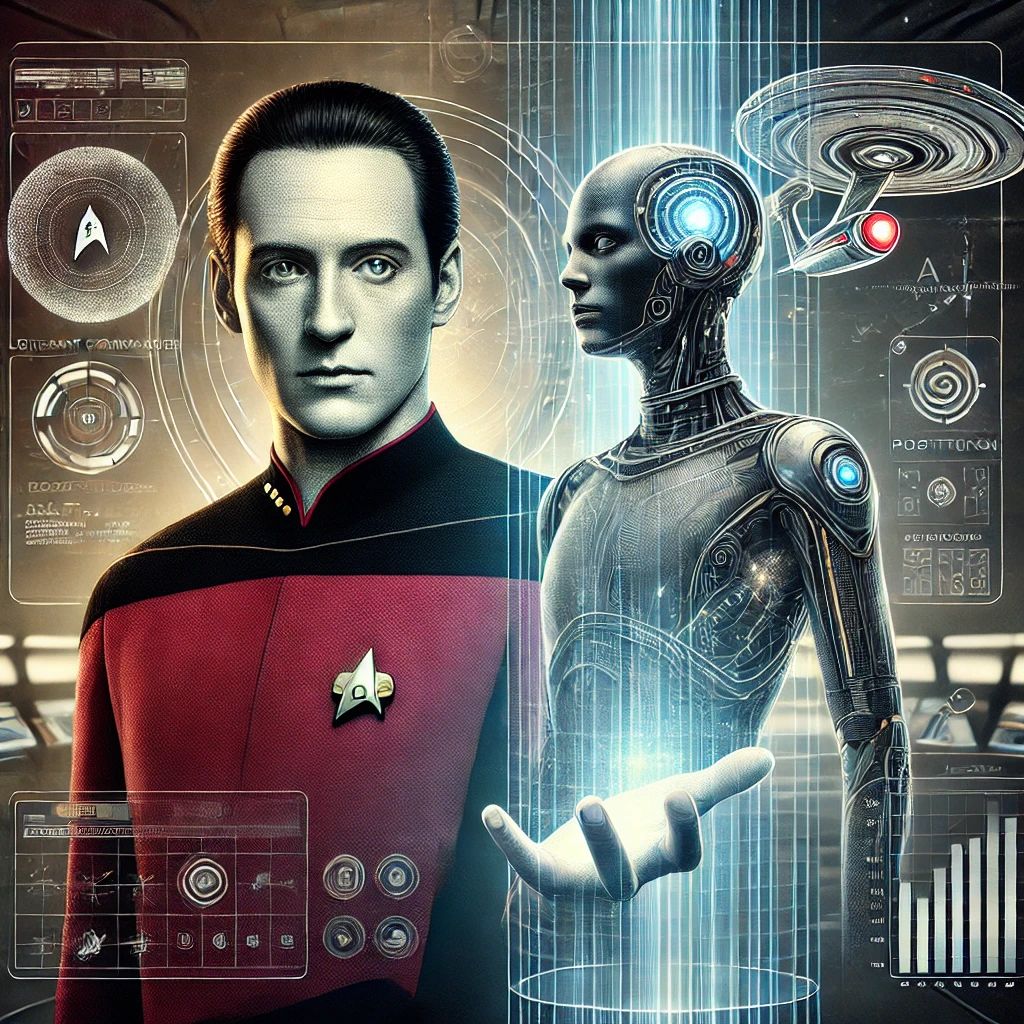
Lieutenant Commander Data, a Soong-type android from “Star Trek: The Next Generation,” serves as the USS Enterprise’s second officer and chief operations officer. Data possesses a positronic brain with a storage capacity of approximately 88 petabytes and processing capabilities estimated at around 60 trillion operations per second. His design enables human-like reasoning, creativity, and physical interaction, including voice communication and sensory perception.
In contrast, ChatGPT, developed by OpenAI, is an advanced AI language model designed to understand and generate human-like text. The latest version, GPT-4o, introduced in May 2024, is multimodal, capable of processing and generating text, images, and audio in real-time. GPT-4o exhibits rapid response times comparable to human reaction in conversations, with enhanced performance in non-English languages and improved understanding of visual and auditory inputs. Unlike Data, ChatGPT lacks physical form and operates within the confines of digital interfaces, relying on vast datasets for knowledge without consciousness or self-awareness.
While both Data and ChatGPT-4o are designed to emulate human communication and reasoning, Data’s integration of physical presence, consciousness, and sensory perception sets him apart from the purely digital and non-sentient ChatGPT. Data’s ability to interact physically with his environment and his quest for human-like experiences highlight the distinctions between fictional androids and current AI language models.
 Advance Science 🧬